ConversionHealth tests whether the signals guiding paid-media decisions are present, recent, and comparable—then shows exactly how each issue changes recommendation confidence.
A precise budget model cannot repair an unreliable signal.
Conversion-led bidding and budget recommendations inherit the quality of the events beneath them. A missing primary action, a week of spend with no recorded outcomes, or an unavailable platform connection can make an account look inefficient when the real failure is measurement. ConversionHealth separates those conditions before they become budget conclusions.
Inside ConversionHealth
See the measurement risk in budget terms.
ConversionHealth turns read-only platform evidence into a confidence score, a severity-ranked finding list, and a practical fix order.
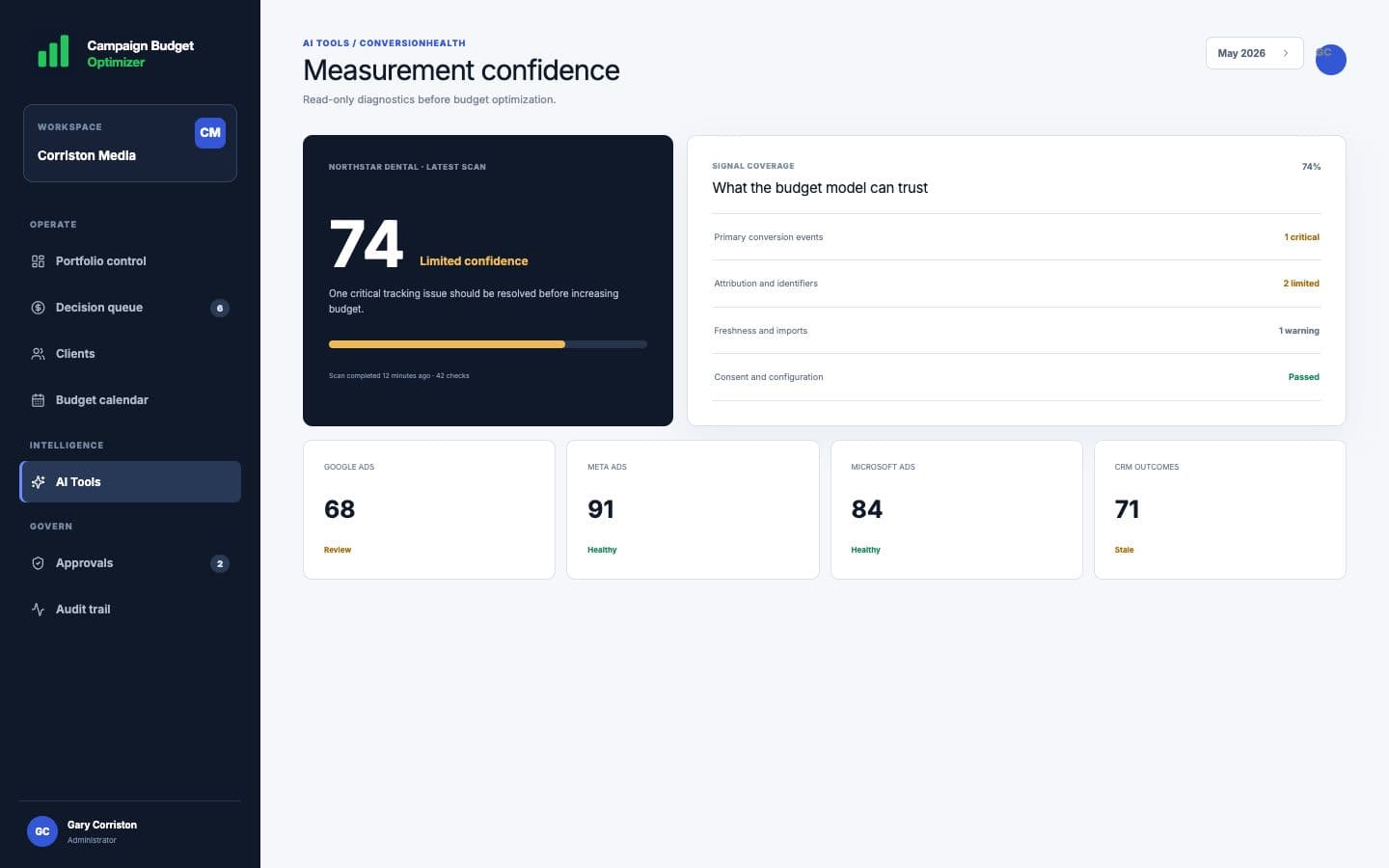
01 · Confidence summaryKnow what the budget model can trust.
Critical gaps and platform-level confidence remain visible before anyone interprets performance.
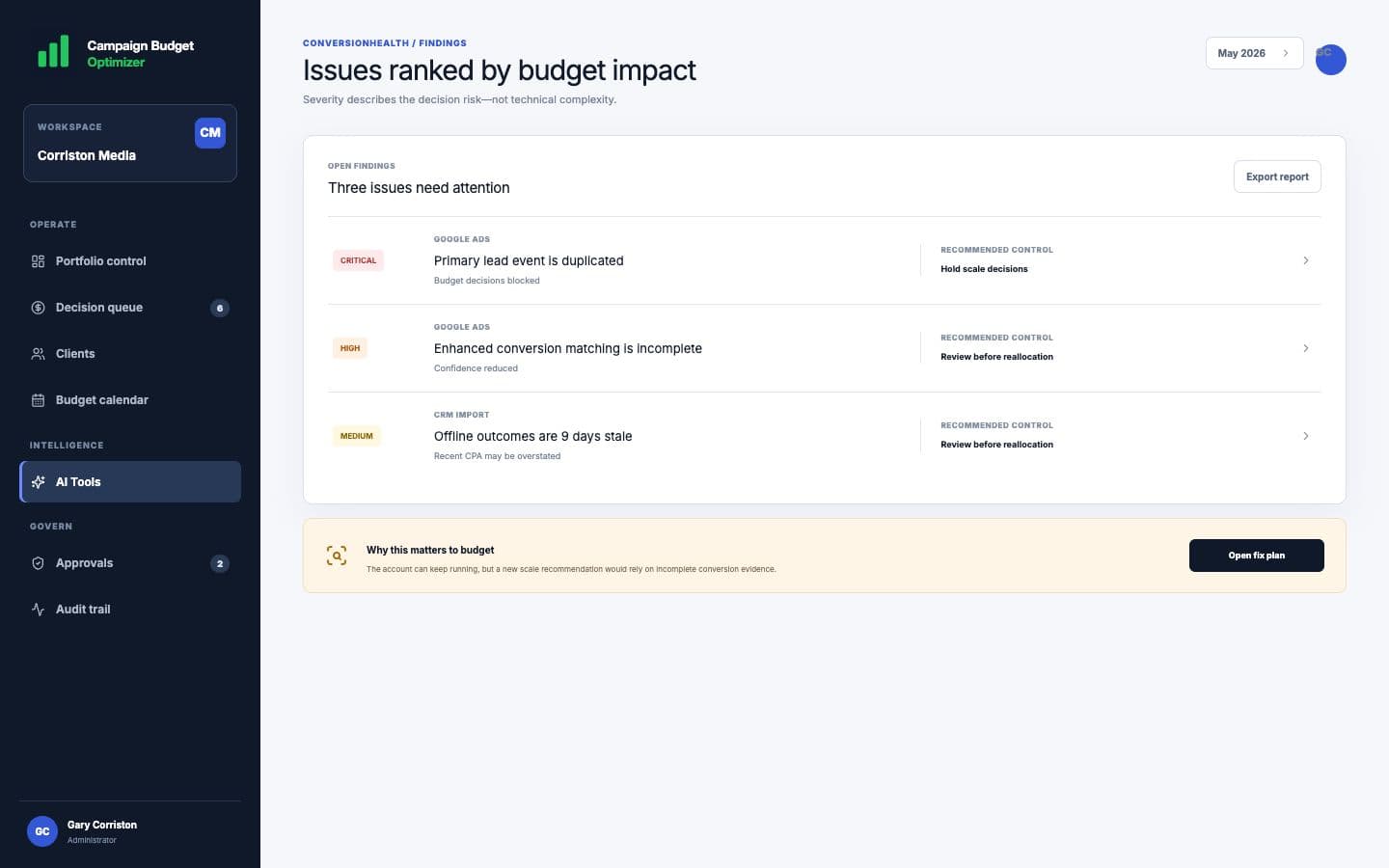
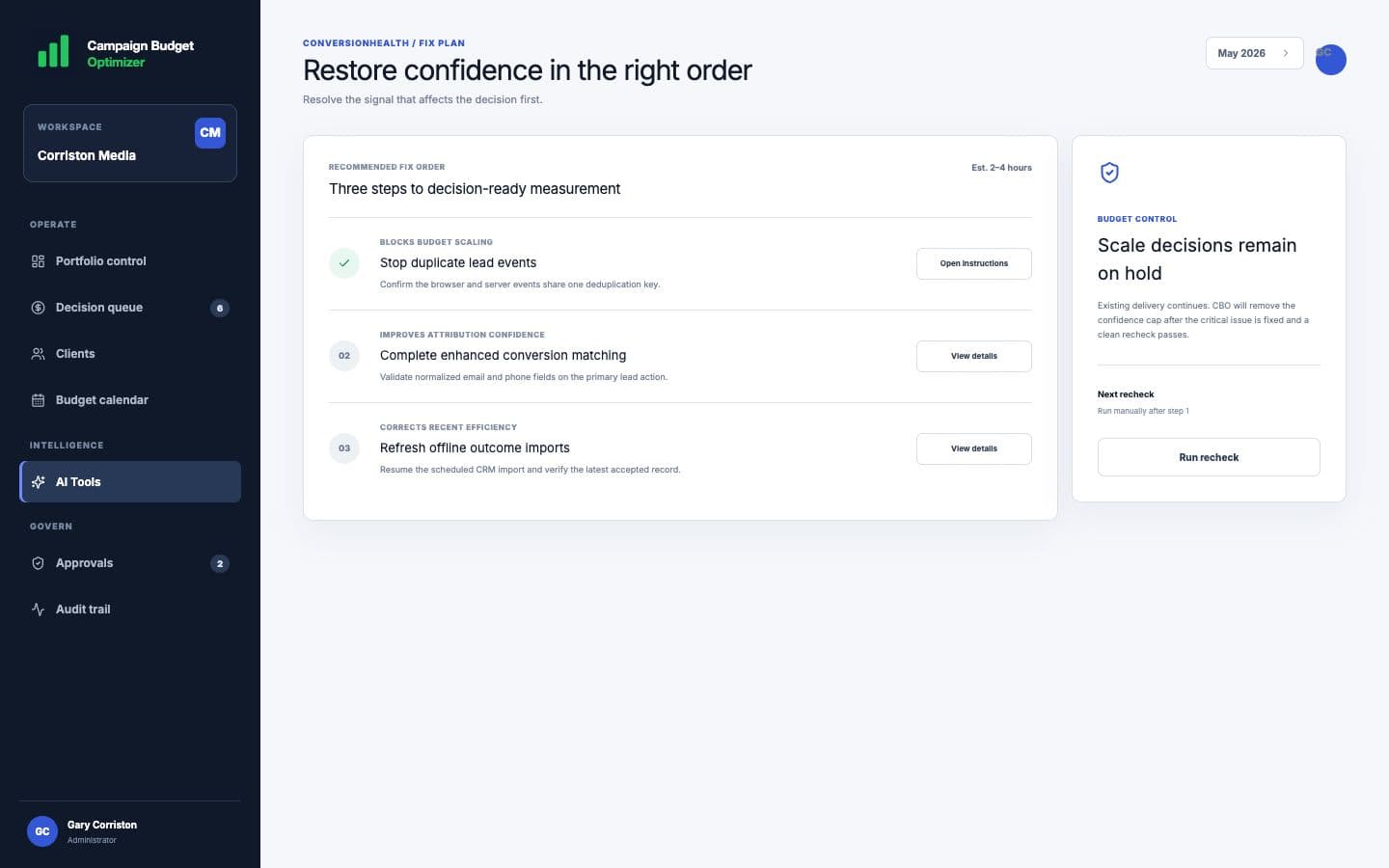
02 · Prioritized findingsRank issues by decision impact.03 · Fix planRestore confidence in the right order.
Seven focused checks
Inspect the signals that can materially change a budget decision.
The built-in diagnostic is intentionally narrower than a full attribution audit. It concentrates on observable conditions that affect CBO’s ability to use conversion data responsibly.
Signal continuity
Is the account still recording its primary outcomes?
Recent activity is checked against active conversion actions and current spend so a tracking break does not masquerade as a performance collapse.
Enabled primary actions with zero events over the applicable 7- or 14-day window
More than $100 in recent spend with no primary conversions recorded
Conversion data that could not be retrieved from the connected platform
Outcome completeness
Are meaningful business outcomes reaching the platform?
Lead-generation accounts often collect value after the website event. ConversionHealth distinguishes online activity from imported or offline evidence.
No offline-origin conversions despite meaningful recent spend
Lead-generation actions reporting only website-pixel conversions
Enhanced Conversions, CAPI, or the platform equivalent available but not enabled
Comparison integrity
Can platform results be compared without hiding a settings mismatch?
Attribution choices change what each platform claims. The diagnostic surfaces different click-through windows before cross-platform CPA or ROAS is treated as comparable.
Primary conversion attribution windows that differ across connected platforms
Platform context retained with every finding
Informational notices separated from score-bearing failures
Freshness and coverage
Is the evidence recent enough to support the current review?
A score without fresh platform data is not presented as certainty. Missing, stale, and coming-soon states stay visible in the confidence layer.
Nightly checks with an on-demand refresh path
Results older than three days treated as directional estimates
Unmeasurable platforms excluded from the weighted account average
Score
A severity-based summary of score-bearing findings on platforms with usable conversion evidence.
Confidence
The operating state CBO uses to qualify how strongly conversion data can support a recommendation.
Freshness
The age and availability of the latest diagnostic—not a claim that delayed platform reporting is a failure.
Confidence, not false precision
The score changes what CBO is willing to conclude.
Each tier has an explicit operating consequence. A lower score does not merely change a badge; it narrows or pauses the recommendations that depend on trustworthy conversion evidence.
80–100Full confidence
Scorable platforms have fresh data with no score-bearing issue severe enough to limit normal budget recommendations.
CBO responseUse conversion-led recommendations with the normal human review, while reviewing any separately disclosed platform exception.
50–79Limited confidence
Tracking issues may weaken CPA, CPL, or ROAS interpretation on one or more connected platforms.
CBO responseKeep pacing conservative and review the affected signal before a material reallocation.
0–49Tracking needs attention
Critical signal conditions make conversion-led recommendations unreliable.
CBO responsePause CPL-based decisions for the affected platform until the evidence is restored.
No fresh scoreDirectional estimate
No recent usable tracking result is available, or the latest result is stale.
CBO responseTreat recommendations as directional estimates and refresh the diagnostic.
How the account score is formed
Each scorable platform begins at 100. High, medium, and low score-bearing findings apply documented deductions. The account score is then calculated as a spend-weighted average across connected platforms with usable recent data. A platform with unavailable conversion data is identified separately and excluded from that weighted average.
What does not reduce the score
Offline-conversion coverage, online-only lead signals, and enhanced-conversion opportunities are currently advisory inside CBO. They can materially improve measurement quality, but they do not always make budget pacing unsafe. ConversionHealth labels them separately so a useful opportunity does not read like a confirmed tracking failure.
The evidence chain
Every finding connects an observed signal to a budget consequence.
The interface keeps the raw observation, the diagnostic interpretation, and the decision boundary together. That gives an analyst enough context to challenge the finding instead of asking the team to trust an unexplained score.
Observed
$4,820 spent in 7 days. Zero primary conversions returned.
The platform connection is active, but recent conversion reporting does not contain a usable primary outcome.
Interpreted
Tracking failure is more likely than a sudden performance failure.
The finding is high severity because spend continued while the signal disappeared across the review window.
Decision boundary
Conversion-led recommendations move to directional estimates.
CBO stops presenting CPL-based guidance as reliable until the signal returns and a fresh check confirms it.
Prioritized findings
A review queue built for operators, not an alarm feed.
Severity reflects the likely effect on recommendation safety. Evidence windows and platform context help the owner distinguish a real break from low volume, normal reporting delay, or an optional improvement.
HighGoogle Ads · Signal continuity
Spend with zero conversions tracked
Recent spend crossed the diagnostic threshold while enabled primary actions returned no recorded conversions.
Budget impact
CPA and CPL recommendations are estimates until tracking is restored.
MediumMeta Ads · Primary action
“Qualified lead” has zero recent events
The action remains enabled but did not fire during the volume-adjusted review window.
Budget impact
Platform optimization may be learning from an incomplete outcome set.
AdvisoryMicrosoft Ads · Signal quality
Enhanced conversion coverage is available
A server-assisted signal may improve resilience where browser-only tracking loses events.
Budget impact
Useful improvement; it does not reduce the current score by itself.
Platform-aware by design
One confidence layer. Platform evidence stays distinct.
ConversionHealth does not flatten unlike systems into a single generic checklist. Each finding retains its source platform, available fields, reporting window, and connection state.
From connection to a defensible confidence decision.
The diagnostic never applies an external account change. Findings remain advisory until the account owner investigates and acts in the platform or implementation environment.
01
Connect
Authorize a supported ad account for read-only reporting access.
02
Scan
Collect recent conversion actions, volume, spend, settings, and availability.
03
Prioritize
Score usable platforms and sort findings by severity and budget impact.
04
Review
Investigate outside CBO, then rerun the check to confirm the signal recovered.
Responsible scope
What ConversionHealth can conclude—and what it cannot.
Strong diagnostic design includes visible limits. The built-in layer does not call every measurement imperfection a blocker, and it does not extend beyond the evidence returned by connected platforms.
How professional teams use it
In-house marketers can run ConversionHealth before a budget review to confirm that recent efficiency changes are supported by usable outcome data. Agencies can use the confidence tier to explain whether a recommendation has full confidence, limited confidence, needs tracking attention, or is a directional estimate. Portfolio leaders can prioritize tracking investigations across accounts without opening every platform first.
Pre-budget-review confidence check
Cross-account issue triage for agency teams
Evidence trail for client and stakeholder conversations
Fresh confirmation after a tracking repair
What the diagnostic does not claim
ConversionHealth is not a tag debugger, attribution-model comparison, incrementality study, consent audit, or guarantee that every reported conversion is accurate. It cannot verify business quality that never reaches the ad platform. A healthy score means the measured platform evidence can support CBO’s budget workflow with stronger confidence—not that the full measurement stack is perfect.
No automatic pixel, goal, campaign, or budget changes
No claim of causal lift or incrementality
Unavailable platform data remains disclosed outside the weighted average
No universal benchmark across unlike business models
Primary measurement references
Built around documented platform evidence.
Connected platform reports remain the source of record. ConversionHealth interprets the available evidence for CBO’s budget-safety workflow and keeps platform reporting limitations visible.
What teams need to know before using tracking confidence in a campaign budget decision.
What does ConversionHealth check?
+
ConversionHealth checks whether connected advertising platforms are returning usable conversion evidence for budget decisions. Current checks cover missing offline conversions, online-only lead signals, enabled actions with zero recent events, spend with no conversions, attribution-window mismatches, enhanced-conversion opportunities, and unavailable platform data.
Does ConversionHealth change pixels, events, or campaigns?
+
No. The ConversionHealth layer inside CBO is read-only. It retrieves supported account data, calculates confidence, and explains findings. It never edits tracking, campaign settings, conversion goals, or budgets.
How is the ConversionHealth score calculated?
+
Each scorable platform starts at 100 and receives deductions for score-bearing findings based on severity. The account score is a spend-weighted average across platforms with usable conversion data. Informational opportunities do not reduce the score, and an unavailable platform is excluded from that average and shown separately.
How is ConversionHealth different from CampaignHealth?
+
ConversionHealth asks whether conversion evidence is trustworthy enough to use. CampaignHealth asks whether campaigns are structured, funded, measured, and performing well enough to support the next investment decision. CampaignHealth uses the latest ConversionHealth result as part of its measurement-confidence pillar.
Is ConversionHealth a complete attribution audit?
+
No. ConversionHealth inside CBO is a focused confidence layer for budget safety, not a complete attribution, tag-management, incrementality, or analytics implementation audit. It prioritizes the signal conditions that can materially affect pacing and allocation decisions.